

Home >Understand the Risks > Hidden Cost Visibility Risks in the Conventional Blended ModelHidden Cost Visibility Risks in the Conventional Blended Model
Published: 11 July 2024   |   Reviewed: 14 September 2026
(2-minute read)
The Structural Feature Most Clients Do Not See
In the conventional litigation model, a single solicitor manages both:
settlement strategy, and
trial preparation.
This arrangement is lawful, common, and often effective.
However, when both functions sit within one role, it becomes difficult for clients to distinguish:
work aimed at early resolution, from
work aimed at preparing for contested hearing.
The challenge is not professional integrity.
It is cost visibility.
When Two Functions Share One Billing Structure
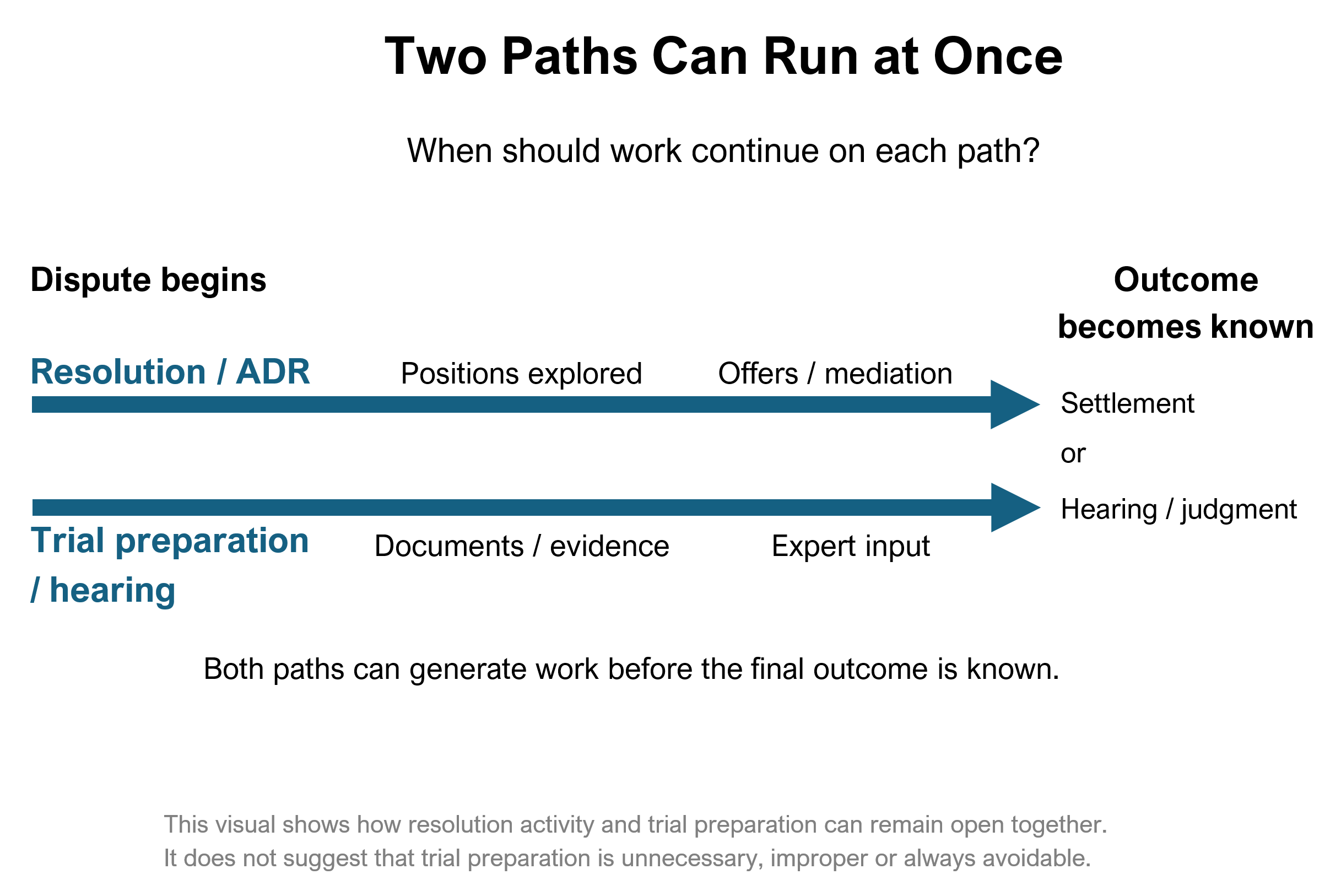
Where settlement and trial preparation coexist inside one role:
timing decisions are centralised
preparatory steps may begin before negotiations conclude
scope expansion may occur gradually
procedural work may commence while resolution discussions remain active
Each of these steps may be professionally justified.
But for clients, the distinction between “resolution work” and “trial preparation” is rarely transparent.
This is where cost visibility becomes complex.
Why Early Fees Do Not Reveal Later Direction
Initial fee estimates often relate only to the early phase of a matter.
They do not necessarily reflect:
whether trial preparation will commence early
whether procedural momentum will build
whether settlement discussions will remain primary
Low entry fees therefore do not determine long-term cost trajectory.
Structure determines trajectory.
Why Switching Becomes Operationally Difficult
When trial preparation has commenced within a blended role:
substantial funds may already have been applied
the file may be subject to lien rights
new practitioners must review existing work
cost continuity becomes complicated
This outcome is not caused by misconduct.
It arises from a single-lane structure in which both functions have already been activated.
A Pattern Many Clients Describe
Clients often express a similar experience:
“The matter began simply. It later became more complex and expensive than anticipated.”
What they are observing is not unpredictability alone.
It is structural convergence of:
dual functions
evolving scope
timing decisions not fully visible at inception
Naming this structure helps clients understand it.
Core Principle
When settlement and trial preparation sit in separate roles, the client can see more clearly which path is being funded.
Clean Law’s structure is designed to align reward with earlier resolution, not procedural expansion.
Further Reading
When Structure Fails (Hartnett case)
Banksia case - governance failure case study
By Nicky Wang
Principal Solicitor