

Why better litigation cost control needs structure, not just warnings
Warnings tell clients litigation may become expensive.
Structure gives them a real chance to act before cost and procedure carry them forward.
Published: 17 March 2026   |   Reviewed: 14 May 2026
(3-minute read)
Home > Why Legal Costs Matter > Why better litigation cost control needs structure, not just warnings
Being warned is not the same as being protected.
That is the problem with litigation costs.
A client can be told that a case may become expensive.
They can be given an estimate.
They can sign a costs agreement.
They can be told more work may be needed.
But once a case starts moving, a warning does not control the bill.
It only tells the client that risk exists.
Litigation costs rarely rise in one dramatic jump.
They build quietly.
One letter.
One conference.
One expert report.
One affidavit.
One timetable change.
One settlement offer.
One more step to stay ready for a hearing that may never happen.
Each step may be reasonable.
Each step may be justified.
Each step may be properly explained.
Together, those steps can become a bill the client never truly chose as a whole.
That is why better litigation cost control cannot depend only on more information.
Information matters.
Disclosure matters.
Warnings matter.
They are not enough if they arrive after the money is committed.
By then, the client may understand more.
They may no longer be able to act on what they know.
That is not control.
That is hindsight.
Real cost control needs structure.
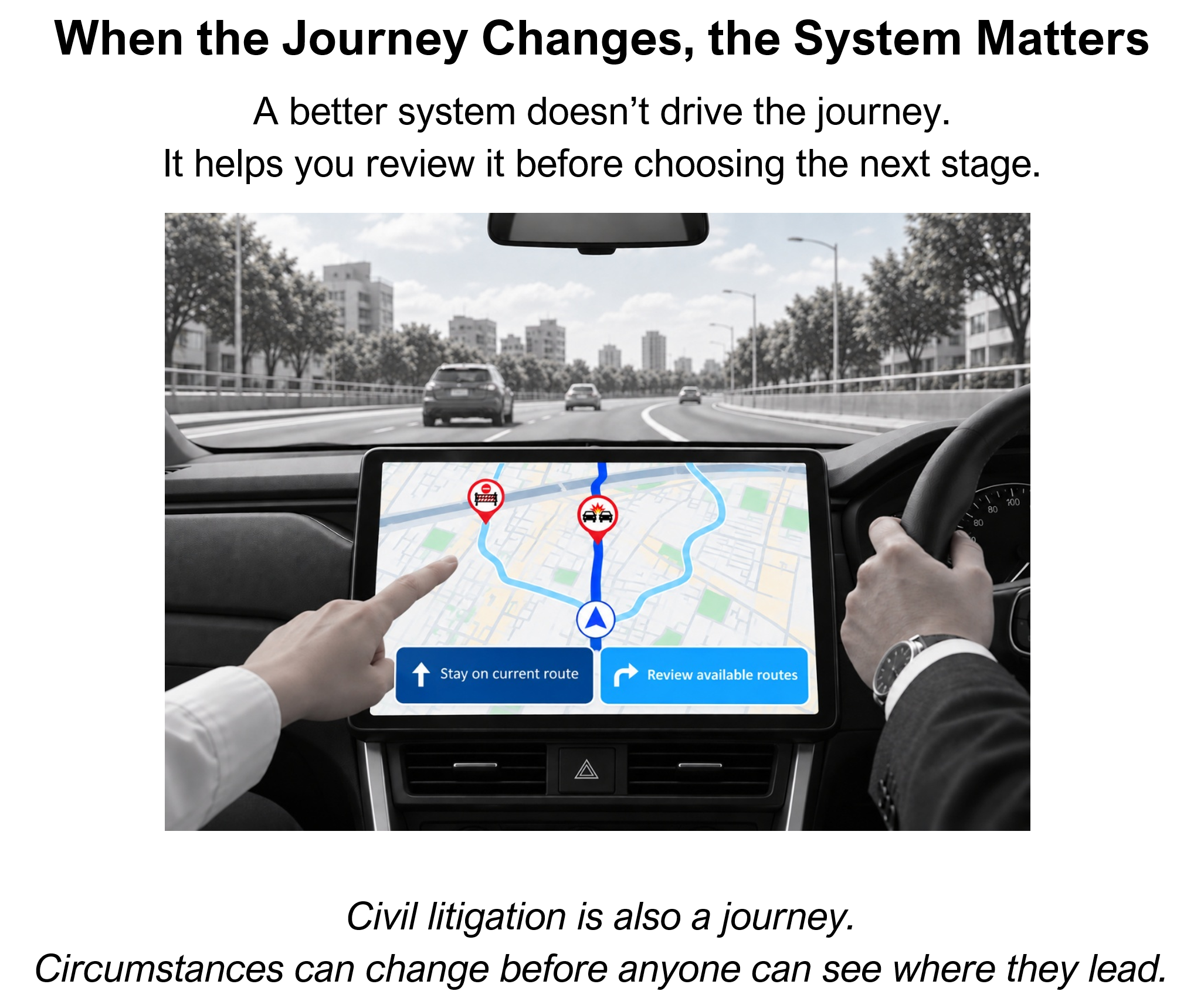
It needs decision points before major costs are incurred, while the client can still stop, compare options and choose.
It needs separated roles, so the person recommending the next costly step is not the only person the client depends on to judge whether that step should be taken.
It needs practical exits, because a right to change lawyers means little if switching brings delay, duplicated work, extra cost and fear of losing momentum.
It needs cost visibility early, before experts are briefed, timetables harden and the client feels trapped.
A warning says:
“This may become expensive.”
Structure says:
“Stop here. See the options. Compare the paths. Choose again.”
Warnings identify risk.
Structure gives people a real chance to act before cost and procedure carry them forward.
And in litigation, the brake matters more than the warning.
By Nicky Wang
Principal Solicitor
Further reading
If the problem is structural, the safeguards also need to be structural.
Why Two Lawyers Often Cost Less Than One
How role separation can make cost exposure visible before it expands.
Two-Lawyer Collaboration & Escrow Oversight Statement
How independent cost oversight, settlement support and escrow authority can operate without interfering with courtroom advocacy.