

Home > How Your Case Is Managed > Switching FlexibilitySwitching Flexibility
Changing Strategy or Changing Lawyer During Litigation
Published: 1 December 2025 | Reviewed: 26 September 2026Litigation can become hard to move once money, timing and file control become tangled.
A client may want to change direction.
A client may later want to change lawyer.
Sometimes the right next step is to apply pressure through court action.
Sometimes the better next step is to reduce tension through early dispute resolution.
Switching flexibility is about keeping those choices real before the case becomes too expensive, too urgent or too difficult to redirect.
The Problem
In a conventional trust-account model, funds are often drawn as work progresses.
The same lawyer may hold:
the client’s file
the funds for working on the next step
practical control over the next step
If the client wants to change lawyers mid-matter, practical problems can arise.
There may be:
disputed invoices
urgent court deadlines
difficulty transferring the file quickly
funds already drawn for work not yet complete
file-retention issues while costs are resolved
This is commonly referred to as a lien.
A lien is a recognised legal mechanism that may allow a lawyer to retain a file in certain circumstances until costs are addressed.
These mechanisms are lawful.
But in practice, they can make mid-case changes stressful or financially complex.
What Clean Law Changes
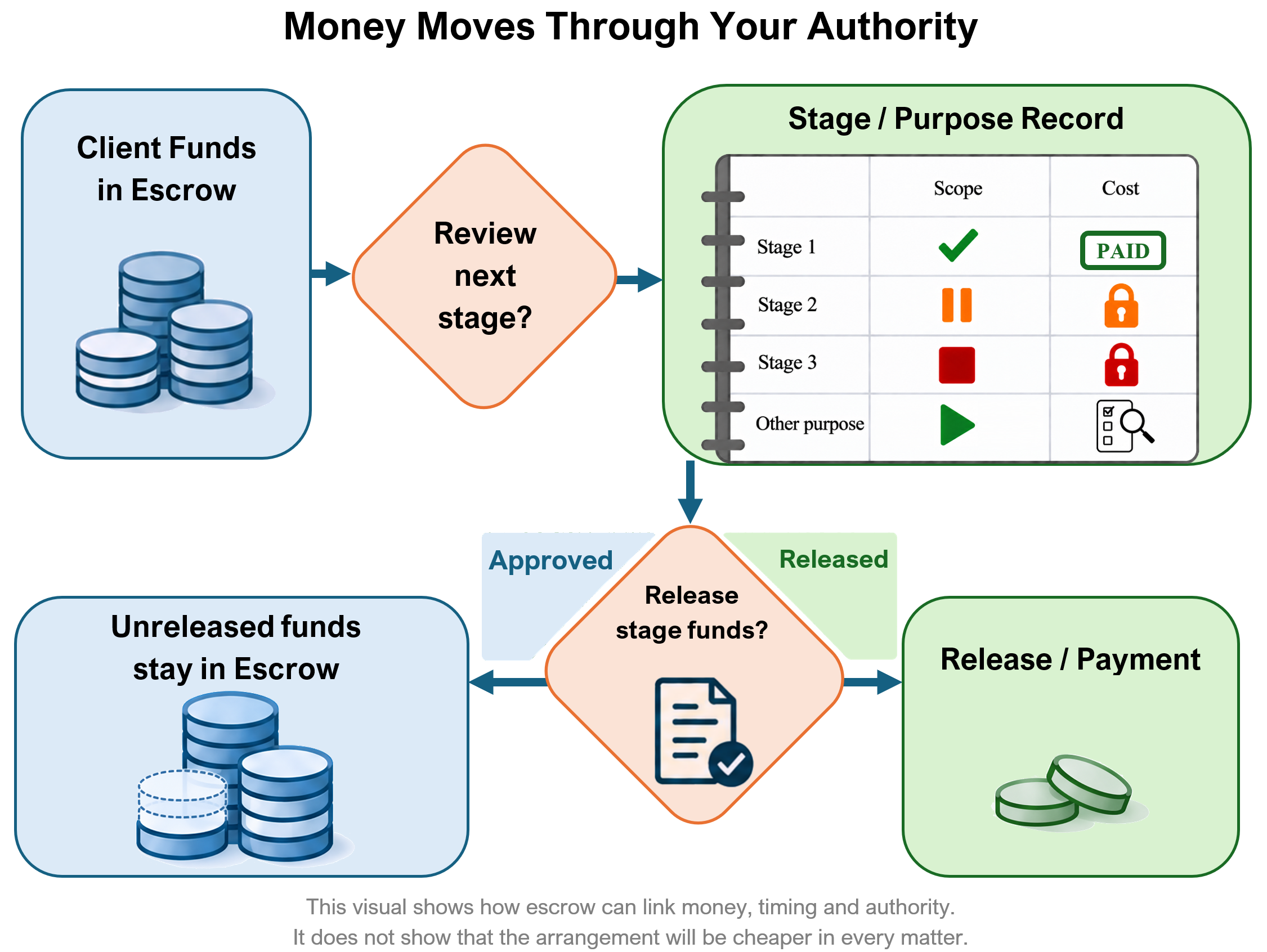
Clean Law separates litigation funding into defined stages.
Funds are held as trust money under the escrow arrangements, with payment and release governed by the applicable authority, signed agreements and law.
This means the client is not simply funding a moving process.
Before funds are released for a completed stage, the client has an opportunity to decide whether the next stage should be funded.
That matters because switching flexibility has two parts:
easier to change litigation strategy before further cost is committed, and
easier to change courtroom lawyers if needed.
1. Easier to Change Courtroom Lawyers
At the end of each funded stage, the work should be easier to identify.
The client can see:
what stage was approved
what work was completed
what materials were produced
what payment was authorised
what remains to be done
That makes the position clearer if the client decides to change courtroom lawyers.
Because each funded stage has a defined scope, completed work and documented payment, it is easier for everyone to see what has been finished, what has been paid for, and what remains to be done. That can make changing courtroom lawyers more straightforward than if those matters were still mixed together.
2. Easier to Change Strategy
This is often more important.
Litigation is not only a choice of lawyer.
It is a sequence of decisions.
At different points, the client may need to ask:
should we keep applying pressure through court steps?
should we pause and attempt early dispute resolution?
should we narrow the issues?
should we seek a practical commercial resolution?
should we fund the next stage at all?
Those questions are harder to ask when the next stage has already been paid for, the file is difficult to move, or the client feels carried forward by momentum.
Stage-based escrow creates clearer pause points.
Before further funds are released, the client can look at the matter and decide whether the next step should:
escalate pressure
reduce tension
support settlement discussions
prepare for the next court step
change direction
This does not guarantee settlement.
It does not make litigation risk-free.
It does not mean court pressure and dispute resolution are opposites.
It means the client has a clearer moment to decide which path should be funded next.
Why Escrow Matters
Escrow does not remove legal rights concerning liens.
Its function is more practical.
It helps separate:
earned work from unearned funds
completed stages from future stages
lawyer payment from automatic forward momentum
court escalation from settlement or EDR decisions
That separation helps preserve the client's practical ability to change direction before further cost is committed.
Why Independent Roles Matter
Switching flexibility also depends on separate professional roles.
Clean Law is capable of courtroom advocacy but deliberately refrains from conducting contested hearings within this structure. The separately retained courtroom lawyer remains responsible for courtroom work.
Clean Law does not share profits with, accept referral fees from, or maintain fixed panels of courtroom firms.
This separation helps keep the client-side and courtroom roles distinct when a change of direction or lawyer is being considered.
In Summary
Switching flexibility is supported by stage-based escrow, which helps create:
clearer file records at the end of each stage
clearer pre-defined scope of work
client approval before future funds are released
separate roles for early resolution work and courtroom representation
Together, these features create practical space for clients to change strategy or change lawyers.
This does not remove every practical difficulty in litigation.
Its objective is more modest, and more important:
to make it easier for the client to pause, understand the position, and decide what should happen next before more money is committed.
By Nicky Wang
Principal Solicitor