

Home > How Your Case Is Managed
Two-Lawyer Representation
Two lawyers. One funded path at a time.
Designed to make cost, timing and responsibility clearer from the start.
Published: 25 September 2025 | Reviewed: 26 September 2026The Structural Question
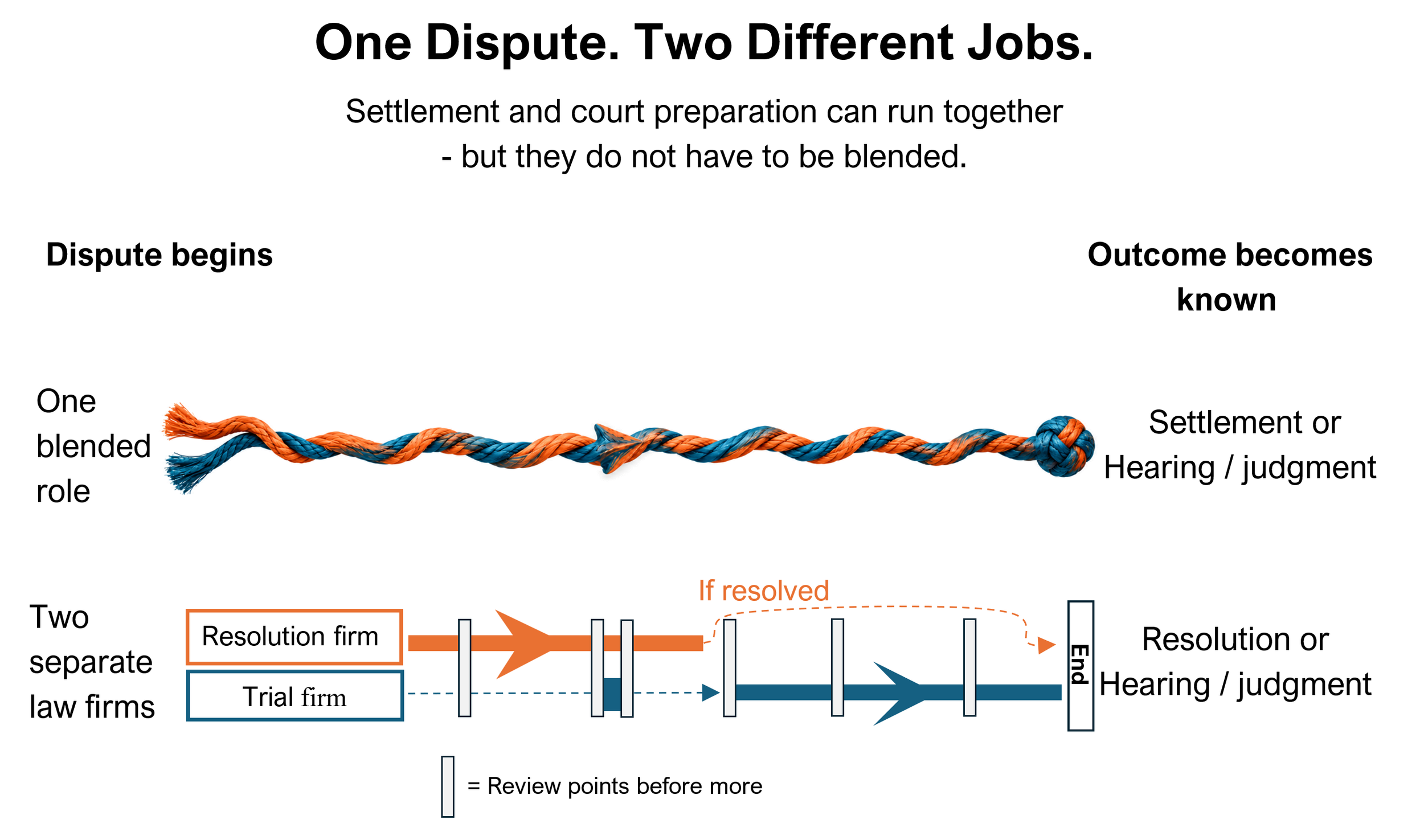
In most litigation matters, the same firm may conduct both:
settlement discussions and mediation, and
preparation for trial, including pleadings and evidence.
There is no duplication of work in that structure.
However, settlement strategy and trial preparation sit within one billing relationship.
When both paths are prepared concurrently, timing and scope may become difficult for clients to see clearly.
If your aim is settlement, you may first want to ask why information about the courtroom alternative could matter at all.
→ Why Would I Want Two Lawyers If I'm Trying to Settle?
Clean Law adopts a different structure.
Two Independent Lanes
Under this structure, your case is managed through two separate roles:
Lane 1: Clean Law
Settlement strategy, mediation, timing control, escrow oversight, and cost-visibility analysis.
Lane 2: Courtroom Lawyer
Pleadings, evidence, contested hearings, and trial advocacy.
Clean Law and any courtroom lawyer are separately retained by the client for different functions.
Clean Law handles its agreed client-side, settlement and escrow work. If contested court work is required, the client chooses and separately retains the courtroom lawyer under a separate costs agreement.
Each practice remains responsible for its own professional work and fees.
Three Structural Protections
These protections arise from structure, not assurances.
1. Independent Early Case Analysis
Clean Law can first provide a fixed-scope client-side analysis of legal options, risks and timing before a litigation pathway is funded. This is separate from courtroom preparation.
Clean Law’s settlement and oversight fees are separate from the courtroom lawyer’s fees.
Where an outcome-linked component applies under the signed costs agreement, it is based on trial costs avoided and is not calculated as a percentage of damages or settlement proceeds.
→ Client Protection Principles Overview
3. Escrow Authority
Client funds are held as trust money and administered through stage-based escrow arrangements.
Work and funding are organised by defined stages, with documented scope, authority and completion criteria under the signed agreements.
Further funding and payment follow the applicable client authority, agreement and law.
→ Escrow: Money, Timing & Authority
Why Separation Matters
Clean Law is capable of courtroom advocacy but deliberately refrains from conducting contested hearings within this structure.
The separately retained courtroom lawyer controls forensic judgment, advocacy decisions and fees, and remains responsible for their own professional duties.
Clean Law’s role remains limited to settlement strategy, timing, cost oversight and escrow supervision.
Governance and Independence
We operate within Legal Profession Uniform Law (NSW) and Solicitors’ Conduct Rules 2015.
Governance safeguards include annual trust-account audit, ACNC governance and reporting, and no referral fees, panels or profit-sharing with courtroom firms.
See:
In Summary
Two independent roles are designed to make settlement work, courtroom work and funding decisions easier for clients to distinguish and manage.
The structure does not promise the lowest cost in every matter. Its purpose is to make roles, stages and funding decisions clearer before further work is committed.
Separation clarifies timing.
Escrow clarifies authority.
Result-based alignment clarifies incentives.
By Nicky Wang
Principal Solicitor