

Home > How Your Case Is Managed > EscrowEscrow: Money, Timing & Authority
How Money, Timing and Authority Stay Visible
Published: 28 November 2025 | Reviewed: 26 September 2026What Escrow Means in Litigation
Ordinary trust-account rules protect client money. They do not, by themselves, create a separate decision point before each funded stage begins.
Under Clean Law’s escrow structure, funds are held through solicitor trust-account arrangements with additional stage-based authority controls. For staged work, release follows the applicable written authority and agreed process, including:
the relevant stage of work and scope
the applicable completion criteria
the authority recorded for that release
Escrow does not replace trust-account compliance.
It adds an additional layer of stage-based authority and release control.
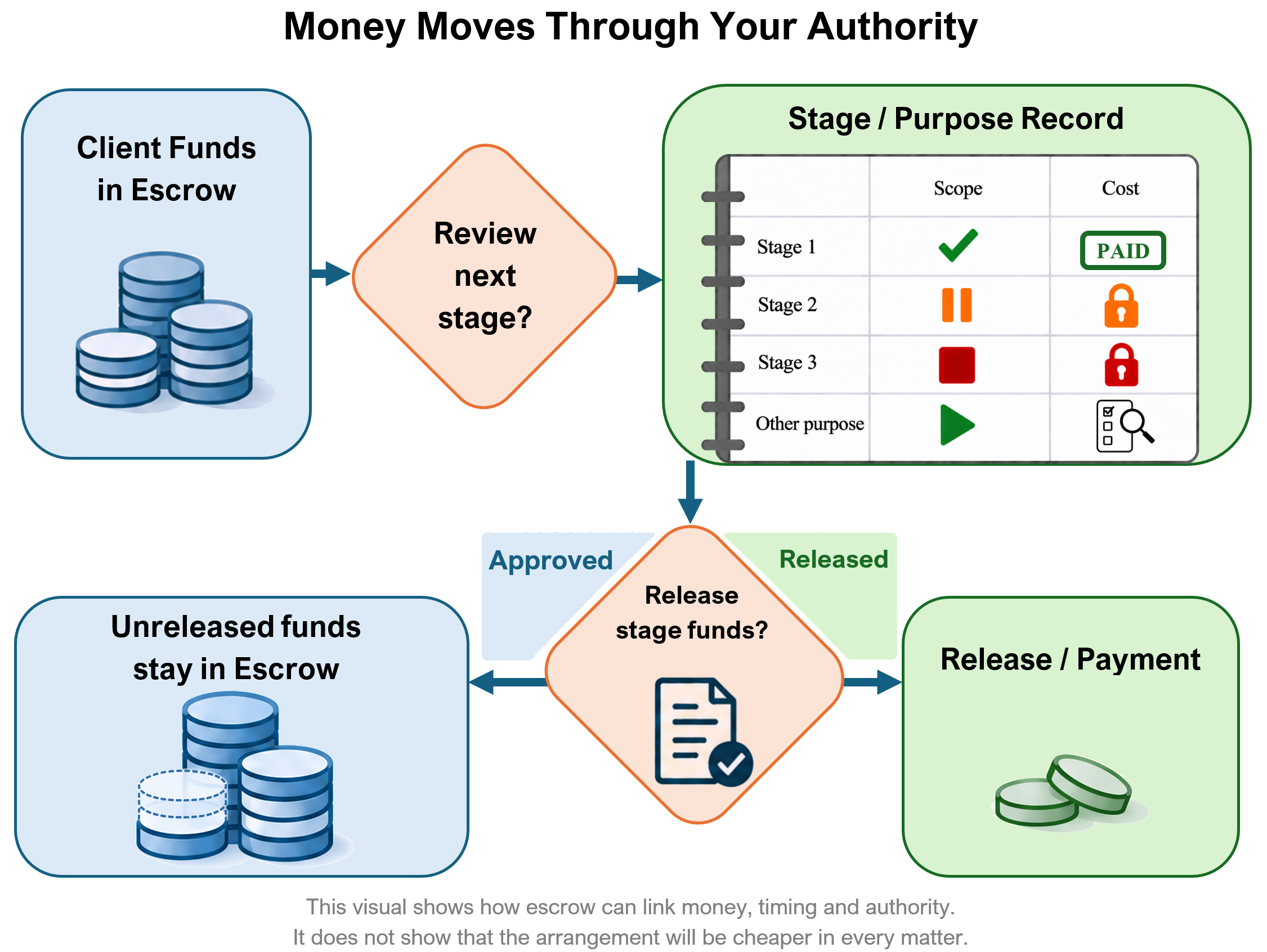
How Escrow Operates
Each matter is divided into defined stages, with scope, completion criteria and records of work performed.
Funds for completed work are released through the applicable agreed process and recorded authority. Future stages require the funding and authority applicable to that stage. Funds not yet released remain within the trust-account arrangement, subject to the signed agreements and applicable law.
What Escrow Helps You Control
Escrow is designed to give you practical control over:
Future Cost Commitments
Fund an agreed stage or purpose without committing at the same time to every foreseeable later stage. Before further funding is committed, you can consider the information then available about the paths ahead and decide what to authorise next.
Some information may only emerge as the dispute develops. A related question is: how much are you prepared to spend before you know more?
→ Read: How Much Are You Prepared to Spend to Find Out?Timing & Direction
Make funding decisions at defined stages as the matter develops. A decision to fund one stage does not, by itself, authorise every later stage. Further work and funding follow the applicable agreement, authority and law.Changing Courtroom Lawyers
Defined stages help distinguish completed work, unreleased funds and outstanding work if you later change courtroom lawyers.Cost Concerns
Review the relevant stage, invoice and applicable release authority before funds are released through the agreed process. If a concern arises, the applicable agreement and law govern how the disputed amount and any continuing work are dealt with.
Why this matters
Cost disclosure tells you what may happen. Escrow gives you a decision point before more money is committed.
Related reading
Interaction With the Two-Lane Structure
Escrow supports the separation described in Two-Lawyer Representation by connecting funding to an approved stage or purpose.
The settlement and courtroom roles remain separately retained, with funding allocated by defined stage or purpose under the escrow arrangements.
→ Two-Lawyer Collaboration and Escrow Oversight Statement (PDF)
for the fuller operating boundary.
Switching and File Release
Defined stages can make completed work, unreleased funds and outstanding issues easier to identify if a client later changes courtroom lawyers.
Governance and Audit
Escrow operates within applicable trust-account, audit and Clean Law governance requirements.
Incentive Alignment
Clean Law's remuneration structure is explained separately from the escrow mechanism.
→ Aligned Incentives & Cost Safety
Summary
Escrow is a stage-based structure that links:
money
the purpose or stage being funded
authority to release funds
It does not make litigation cheap, simple or risk-free.
Its role is more practical: to make money, timing and authority clearer before the next step is funded.
By Nicky Wang
Principal Solicitor