

Why Would I Want Two Lawyers If I’m Trying to Settle?
Because understanding the path you are trying to avoid can help you decide what to do next.
Published: 10 August 2026   |   Reviewed: 27 September 2026
(3-minute read)
Home > Why Legal Costs Matter
If you are trying to settle a dispute, involving a courtroom lawyer can sound unnecessary.
Why bring in another lawyer when nobody wants to go to court?
That is a reasonable question.
But it starts one step too late.
A good retainer should already give you control over spending
Whether you have one lawyer or two, a good retainer should help you understand the substantial work that can reasonably be foreseen.
What work might be required?
What might it cost?
What may or may not be avoided?
What remains uncertain?
What have you actually authorised your lawyer to do now?
And when will you be asked again before substantial further work or cost is incurred?
That kind of discipline can work perfectly well with one lawyer.
A well-structured one-lawyer retainer can give a client strong control over scope, timing and expenditure.
But control over spending leaves another question unanswered:
Should I authorise the next spend at all?
Knowing that you can say “yes” or “no” does not tell you which answer makes sense.
A dispute is rarely just one decision.
An offer arrives.
Do you accept it?
Reject it?
Counter?
Spend more on negotiation?
Try mediation?
Obtain expert evidence?
Prepare for contested proceedings?
Or, if proceedings are already underway, keep negotiating while preparing the case?
Those decisions may arise more than once as the dispute develops.
New evidence may emerge.
Offers may change.
Costs may change.
The other side’s position may change.
Your own priorities may change.
So before deciding what to do next, there is another useful question:
How much would it matter if my present assumptions about the alternative path were wrong or incomplete?
That is different from control over spending.
Control tells you who decides whether money is spent.
It does not necessarily tell you whether the next spend is worthwhile.
For that, you may need information about the alternatives.
Settlement-facing work and courtroom-facing work can involve different purposes, timing, incentives and cost consequences.
Why think about court when everyone is trying to settle?
Suppose both sides genuinely want to resolve the dispute.
You are considering whether to spend another $10,000 on negotiation, mediation or expert work.
Is that sensible?
The answer does not come from the $10,000 figure alone.
It may depend partly on what happens if settlement is not reached.
What would the foreseeable courtroom path involve?
What might it cost?
How long might it take?
What important uncertainties remain?
You do not have to want litigation before that information becomes useful.
In fact:
You may want to understand the potential cost of court precisely because you are trying to stay out of court.
Think about a GPS.
You do not look at another route because you necessarily want to take it.
You look because knowing the alternatives can help you decide whether to stay on the route you are already travelling.
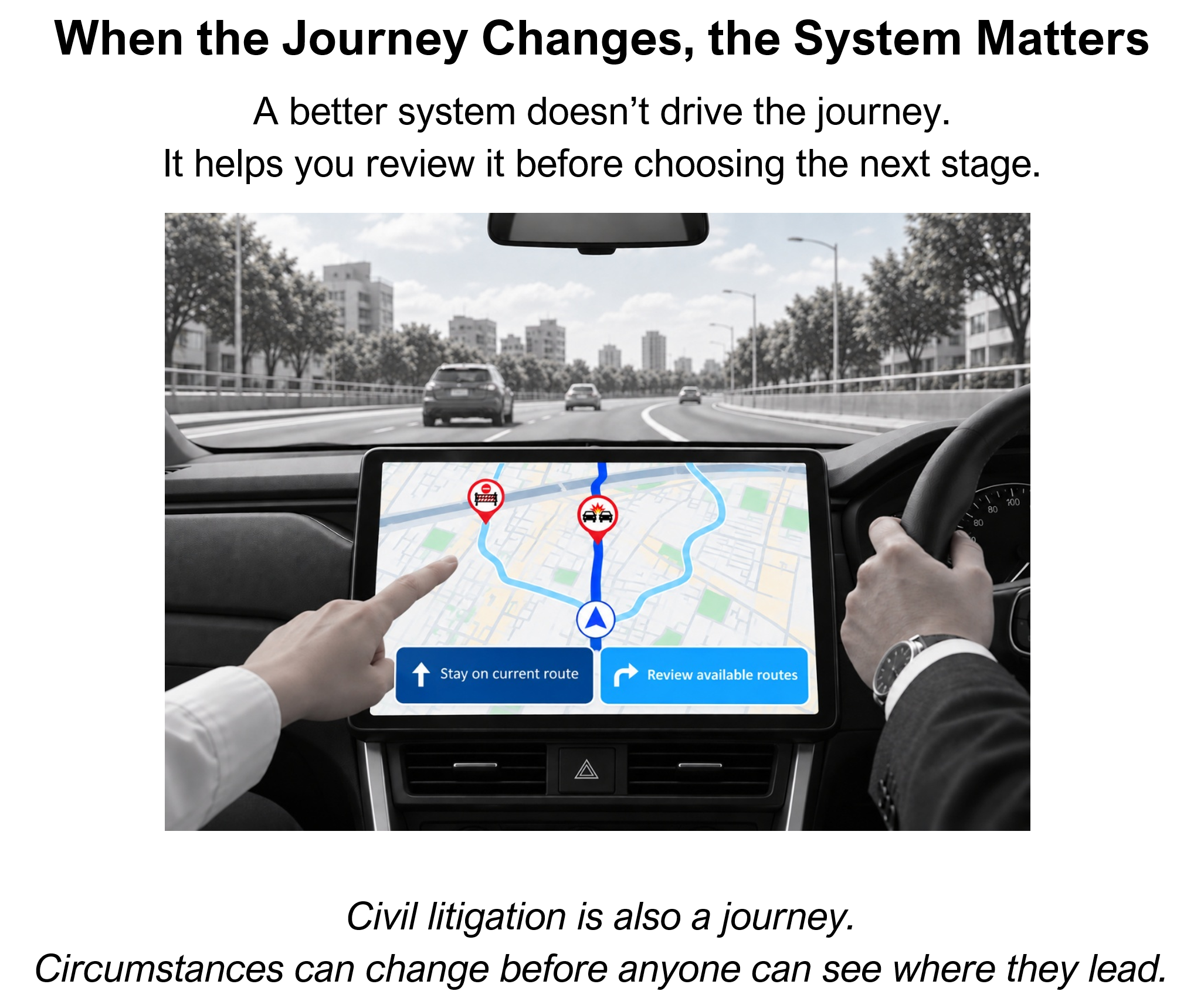
And that decision can change during the journey.
Traffic changes.
Travel times change.
A route that made sense earlier may no longer make sense.
The same can happen in a dispute.
The information available to you can change as the matter develops.
A settlement offer that looked unattractive before new evidence emerged may look different afterwards.
Another round of negotiation that once seemed worthwhile may become difficult to justify.
Or the opposite may occur.
Prospective litigation cost does not determine any of those decisions.
It is one reference point among others.
The amount at stake, legal and factual uncertainty, timing, commercial objectives and the changing behaviour of the parties may all matter too.
But the less you understand about an important alternative, the harder it can be to compare the choices in front of you.
So where do “1-1” and “2-1” come in?
The terms in this article are only shorthand.
A 1-1 retainer means a structure in which settlement-facing and courtroom-facing work can remain within one lawyer or one law firm’s continuing role.
A 2-1 retainer means a structure in which an ADR or settlement lawyer and an independently retained courtroom lawyer perform separate functions for the same client.
The labels are not the important part.
Nor is the question whether one lawyer is inherently better than two.
A good 1-1 lawyer may be highly experienced in both negotiation and litigation.
That lawyer may give realistic cost estimates, create stopping points, control scope, require further authority before new work begins and arrange an independent second opinion when useful.
Two-lawyer separation is not the only way to obtain those protections.
The narrower question is:
If an important decision depends materially on what I think the courtroom alternative involves, how confident do I need to be in those assumptions before acting on them?
Seeing the alternative is not the same as choosing it
A client may hear that litigation could cost a substantial amount and think:
“Are you saying I should spend that?”
No.
Those are different decisions.
Finding out is not proceeding.
An estimate is not an instruction.
Understanding a path is not funding that path.
You can seek information about what the courtroom alternative may involve without deciding to take that path.
And you can revise that information later if the dispute changes.
That distinction matters because the value of the information lies in the decision it helps you make now.
Should you spend more trying to settle?
Should you counter at a different level?
Should you accept an offer that previously looked too low?
Should you prepare more seriously for contested proceedings?
Or has new information made further settlement effort more worthwhile?
Knowing what the available paths may involve can help you decide not only which course to take, but whether to continue it, change direction or reconsider another course as circumstances develop.
Why should I care whether the courtroom view is independent?
Independence matters only if it has practical value.
Suppose your settlement lawyer says:
“I think this offer deserves serious consideration.”
That lawyer may be completely correct.
The lawyer may also be an excellent litigator.
But if rejecting the offer depends heavily on assumptions about the contested path, another question arises:
Are those assumptions important enough to justify the additional cost of having them tested from a separate professional role?
Sometimes the answer will be no.
Your existing lawyer’s assessment may give you everything you reasonably need.
The additional cost and coordination of another lawyer may add little.
But sometimes uncertainty about the courtroom alternative could materially affect what you are prepared to spend, offer, accept, reject or fund next.
In that situation, the client may decide that an independently developed courtroom view is worth obtaining.
That does not mean the second view will necessarily be better or more accurate.
Nor does it imply distrust of the first lawyer.
Its value is narrower.
It gives the client an opportunity to test important assumptions from the perspective of a separate professional role before making a decision that may depend heavily on those assumptions.
The two lawyers may agree.
They may not.
Disagreement is not automatically useful.
But sometimes it exposes the real decision more clearly.
The question becomes less: “Do I like this offer?”
and more:
“Given what the alternative appears to involve, what am I prepared to spend, risk or wait for instead?”
The decision remains the client’s.
Doesn’t involving another lawyer mean more cost?
It can.
It can also mean additional coordination and another lawyer becoming familiar with the dispute.
Those costs should not be ignored.
The more useful question is:
What additional information am I paying to obtain, and could it materially change an important decision?
Obtaining a prospective courtroom view does not itself mean retaining that lawyer to conduct the whole case.
It does not commence proceedings.
It does not authorise the estimated litigation expenditure.
And it does not mean funding the whole courtroom path.
The cost of obtaining that information may also depend on how it is produced.
Where useful case information has already been prepared to understand and manage the dispute, some of it may also assist a prospective courtroom lawyer without requiring the entire matter to be reconstructed from the beginning.
The proportionality question is therefore not simply whether another lawyer costs money.
It is whether the decision ahead is important enough, and sufficiently dependent on uncertain assumptions about the alternative, to justify the cost of testing them.
What about fees and incentives?
Fee structure raises a separate set of questions.
A fixed or capped fee can create a cost boundary for a defined scope.
But a cap does not mean unlimited work.
Where remuneration depends on a defined result, that may create a different incentive again.
Role separation addresses another question.
Client authority addresses another.
No remuneration structure removes every incentive concern.
The useful question is whether the client can see where those incentives and boundaries sit before deciding what to authorise.
So when might separate courtroom input be worth considering?
Not every dispute needs it.
Not every decision justifies the extra cost or coordination.
An excellent one-lawyer arrangement may provide everything the client reasonably needs.
The practical test is narrower:
Before deciding what to do next, how confident am I about what the alternative path may involve and cost?
Then:
Could better information about that alternative materially change what I am prepared to spend, offer, accept, reject or fund next?
And, if it could:
Are those assumptions important enough to justify the additional cost of having them independently tested?
If the answer is no, separate courtroom input may add little.
If the answer may be yes, the client can decide whether obtaining that information is proportionate to the decision at stake.
Seeing another route does not mean taking it.
Sometimes its value lies in helping you decide whether to stay on the route you are already travelling or whether new information has changed what makes sense next.
By Nicky Wang
Principal Solicitor
Further reading
Two-Lawyer Representation
How settlement-facing and courtroom-facing work can be separated into different roles.
Independent Tendering
How a client can obtain and compare proposals for prospective courtroom work.